
Introduction
Cricket commands a colossal global audience, with passionate fanbases stretching from Mumbai to Melbourne and from Lahore to London. For someone who has never watched a single over bowled, though, the sport can feel like a puzzle wrapped in mystery. The vocabulary alone—googlies, yorkers, silly points, third man—sounds like a secret code.
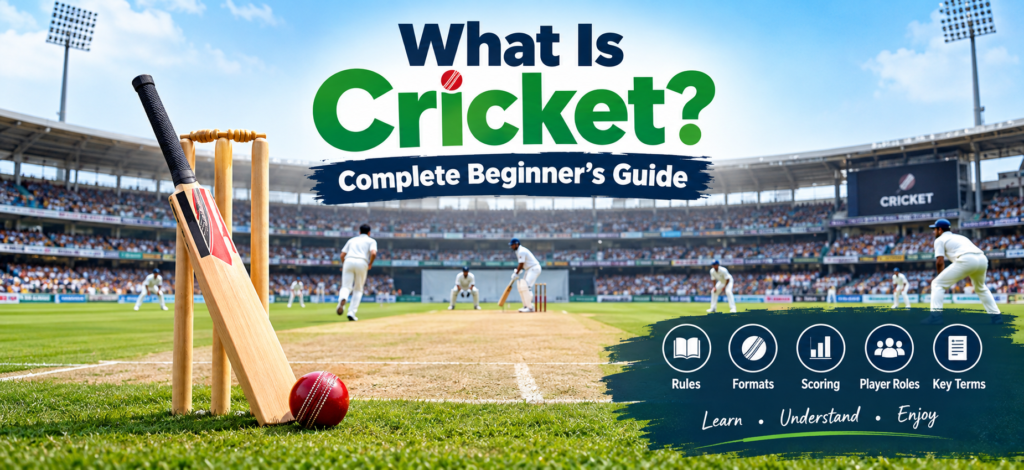
Here’s the comforting truth: once Cricket is explained clearly, the game reveals itself as remarkably logical. Two squads go head-to-head. One wields the willow; the other hurls the leather. The side that racks up more runs celebrates victory.
This handbook walks you through what cricket is, how cricket is played, the foundational rules, the three principal cricket formats, how cricket scoring operates, the various ways batters perish, and the vital cricket terms every rookie ought to master. Once you’ve absorbed these cricket basics, you’ll watch any match with genuine insight.
Want to amplify your cricket journey with live wagering? Secure your trusted cricket betting ID through 99exch Cricket ID—a premier destination delivering instant T20 Cricket IDs and highly competitive odds.
What Is Cricket?
Cricket is a bat-and-ball contest waged between two squads, each boasting eleven players. Battles unfold on an expansive oval ground, with a rectangular strip known as the pitch occupying the middle. At either end of this strip stand three timber stumps crowned by two small bails—together called a wicket.
The essential aim couldn’t be simpler. One squad assumes batting responsibilities, striving to amass the maximum runs possible. The rival squad bowls and fields, seeking to remove batters and curtail the scoring. After a prescribed number of overs or wickets, the two squads exchange duties.
Whichever outfit concludes with a superior run tally claims victory. If both squads finish level, the contest is deemed a tie. Under certain formats, time expiration can also yield a draw.
Cricket basics sit atop this wonderfully uncomplicated structure. What elevates cricket above other sports is its extraordinary spectrum—from three-hour T20 spectacles to five-day Test marathons. This breadth explains cricket’s fierce worldwide devotion.
How Is Cricket Played?
Let’s dissect how cricket is played in plain, jargon-free language.
Teams and Players
Each squad deploys eleven players. While one outfit bats, the other handles bowling and fielding responsibilities. The batting side dispatches two batters onto the pitch together. The bowling side stations one bowler to hurl the ball, backed by ten fielders spread across the ground.
Innings
An innings signifies a squad’s turn at the crease. Format dictates whether squads bat once or twice. Limited-overs cricket grants each side a solitary innings. Test cricket permits two innings per side.
Batting
The batter takes stance before the stumps, Willow in hand. Their mission: strike the ball and harvest runs either by dashing between the wickets or sending the ball to the rope.
Bowling
The bowler releases the ball from the opposite end of the pitch. Their aim is to remove the batter or choke run-scoring avenues.
Fielding
The ten fielders arrange themselves strategically to block the ball, pouch catches, or execute run-outs.
Overs
An over encompasses six legal deliveries from one bowler. Upon an over’s completion, a fresh bowler operates from the opposite end.
Wickets and Runs
The term “wicket” wears two hats. It denotes the three stumps and bails, and it also describes a batter’s dismissal. A run functions as cricket’s foundational scoring unit.
Basic Cricket Rules
These represent the indispensable cricket rules for beginners every newcomer must absorb.
How Batting Works
Two batters inhabit the pitch at all times. The striker confronts the delivery and attempts to score. The non-striker awaits at the opposite end. Both sprint between the wickets to pile up runs.
How Bowling Works
The bowler dispatches six balls per over. The arm must stay straight throughout delivery. Should the bowler’s foot breach the crease, it’s called a no-ball.
How Fielding Works
Fielders may intercept the ball with any body part. They can snag the ball directly to dismiss a batter. They can also run out batters by crashing the ball into the stumps.
How a Batter Gets Out
Dismissals materialize in numerous ways. The most prevalent are bowled, caught, LBW, run out, stumped, and hit wicket.
How Innings End
An innings terminates when ten batters fall, the allocated overs expire, or the batting side declares (applicable in Test cricket).
How the Winner Is Determined
The squad with the larger run collection triumphs. Level scores produce a tie. In Test cricket, elapsed time delivers a draw.
Cricket Formats Explained
Cricket unfolds across three principal formats. Each carries its own rules, duration, and flavor.
Test Cricket
Test cricket occupies the longest format. Contests can stretch across five days. Each squad bats twice. No over ceilings apply. Test cricket rewards patience, technique, and endurance. Outcomes remain uncertain—draws happen often.
One Day International (ODI)
ODI cricket belongs to the limited-overs family. Each squad bats for 50 overs. One innings per side. ODIs generally consume around eight hours. This format graces marquee tournaments like the ICC Cricket World Cup.
T20 Cricket
T20 represents the shortest format. Each squad bats for 20 overs. One innings per side. A T20 contest wraps up in roughly three hours. This format serves up fast, explosive entertainment—perfect for newcomers. Competitions like the IPL have catapulted T20 cricket to staggering global fame.
Cricket Field and Pitch Explained
The cricket field is a sprawling oval ground. A rectangular pitch, typically 22 yards long, sits at the center. Three stumps crowned with two bails stand at either end.
Key field zones include:
- Pitch – The central strip where bowling and batting unfold
- Wickets – The stumps and bails stationed at each end
- Batting Crease – The line marking where the batter stands
- Bowling Crease – The line from which the bowler releases
- Boundary – The outer perimeter of the field (rope or fence)
- Inner Field – The zone near the pitch where fielders operate
- Outfield – The area between the inner field and the boundary
How Are Runs Scored in Cricket?
Cricket scoring revolves around runs. Here’s how squads accumulate them.
Running Between Wickets
After striking the ball, batters dash to the opposite end. Each completed run adds one run. Multiple runs become possible if the ball travels far.
Four
When the ball reaches the boundary after touching the ground, the batting side banks four runs.
Six
When the ball clears the boundary without touching the ground, the batting side banks six runs.
Extras
Extras are runs gifted to the batting side without the batter making contact. Common extras include wides, no-balls, byes, and leg byes.
Boundaries
Boundaries supply the swiftest scoring route. A four or six can flip a match’s momentum in a heartbeat.
How Does a Batter Get Out?
Ten dismissal methods exist in cricket. Here are the most common ones.
Bowled
The bowler crashes into the stumps, dislodging the bails.
Caught
A fielder pouches the ball before it touches the ground.
LBW (Leg Before Wicket)
The ball thuds into the batter’s leg when it would otherwise have crashed into the stumps.
Run Out
A fielder smashes the stumps while the batter is outside the crease.
Stumped
The wicketkeeper dislodges the stumps while the batter is out of the crease.
Hit Wicket
The batter accidentally collides with the stumps using their bat or body.
What Is an Over in Cricket?
An over comprises six legal deliveries from one bowler. After each over, a different bowler operates from the opposite end.
If the bowler sends down a wide or no-ball, that delivery doesn’t count toward the six balls. Consequently, an over may contain more than six deliveries.
A maiden over occurs when no runs are scored off the bat (excluding extras).
Player Roles in Cricket
Every cricket squad features players with specialized roles. Here’s what each entails.
Batsman/Batter
The batter’s responsibility is scoring runs and safeguarding their wicket. Batters may adopt aggressive (hitting) or defensive (anchoring) approaches.
Bowler
The bowler’s task is taking wickets and restricting runs. Bowlers fall into pace (fast) or spin (slow) categories.
All-Rounder
An all-rounder contributes with both bat and ball. They’re invaluable assets to any side.
Wicketkeeper
The wicketkeeper positions behind the stumps to catch the ball. They can also stump batters and execute run-outs.
Captain
The captain leads the squad, sets field placements, and makes tactical decisions.
Important Cricket Terms for Beginners
| Cricket Term | Simple Meaning |
|---|---|
| Run | A unit of score |
| Wicket | Stumps, dismissal, or a batter’s wicket |
| Over | Six legal deliveries |
| Boundary | Four or six scored without running |
| Innings | A team’s turn to bat |
| Yorker | A delivery aimed near the batter’s feet |
| Maiden Over | An over with no runs conceded |
| Strike Rate | Runs scored relative to balls faced |
| Economy Rate | Runs conceded per over bowled |
| Duck | A batter dismissed for zero runs |
| Century | 100 runs scored by a batter |
| Half-Century | 50 runs scored by a batter |
| Powerplay | First six overs with fielding restrictions |
| DRS | Decision Review System for umpire calls |
How Does a Cricket Team Win?
Victory in cricket hinges on the format and match situation.
Comparing Scores
The squad with more runs wins.
Chasing a Target
The squad batting second tries to surpass the first squad’s total.
Winning by Runs
If the squad batting first defends their total, they win by runs.
Winning by Wickets
If the squad batting second reaches the target, they win by wickets (number of wickets remaining).
Tie
If both squads score the same runs, the match is tied.
Draw
In Test cricket, if time runs out, the match is a draw.
No Result
If rain or bad light stops play, the match can be abandoned with no result.
Frequently Asked Questions
What is cricket?
Cricket is a bat-and-ball sport played between two teams of eleven players. One team bats, the other bowls and fields. The team scoring more runs wins.
How many players are there in a cricket team?
Each cricket team has eleven players on the field.
How many formats of cricket are there?
There are three main formats: Test cricket, ODI (One Day International), and T20 cricket.
What is an over?
An over is a set of six legal deliveries bowled by one bowler.
What is a wicket?
A wicket refers to the three stumps and two bails at each end of the pitch. It also refers to a batter’s dismissal.
How are runs scored in cricket?
Runs are scored by running between the wickets, hitting boundaries (four or six), or through extras.
What is the difference between Test, ODI, and T20 cricket?
Test cricket lasts five days with two innings per team. ODI cricket has 50 overs per side. T20 cricket has 20 overs per side. T20 is the shortest and fastest format.
How does a cricket team win a match?
The team with more runs wins. In limited-overs cricket, the team batting second can win by chasing the target. In Test cricket, a match can be drawn if time runs out.
Conclusion
What is cricket? Now you know. Cricket turns simple once you grasp the fundamentals. Two squads compete. One bats, one bowls. Runs accumulate through hitting the ball and running between the wickets. Wickets tumble through dismissals.
The three primary cricket formats—Test, ODI, and T20—deliver distinct playing experiences. Test cricket rewards patience and strategy. ODI cricket offers balance. T20 cricket brings speed and explosiveness.
Familiarity with cricket terms like “over,” “wicket,” “innings,” and “boundary” makes watching matches significantly more enjoyable. Whether you’re tuning into an IPL fixture or a Test match, the fundamentals stay constant.
With these basics mastered, you can follow any cricket match confidently. Enjoy the game!
Eager to elevate your cricket viewing with live wagering? Secure your Cricket betting ID from 99exch. Visit 99exch Cricket ID today! Already registered? Just complete your 99exch login. New user? Do your 99exch signup and register now to claim your welcome bonus.
Make sure to read the Terms & Conditions and Privacy Policy before playing. You can also explore exciting casino games on the platform.
Get Started Today:
- 99exch Cricket ID
- 99exch login
- Betting ID
- 99exch signup
- Register Now
- Casino Games
- Get ID on WhatsApp
Disclaimer: This article is for informational purposes only. It is intended to help beginners understand the basics of cricket. Please check your local laws before participating in online betting. Gamble responsibly. You must agree to the 99exch ID Terms & Conditions before using the platform.